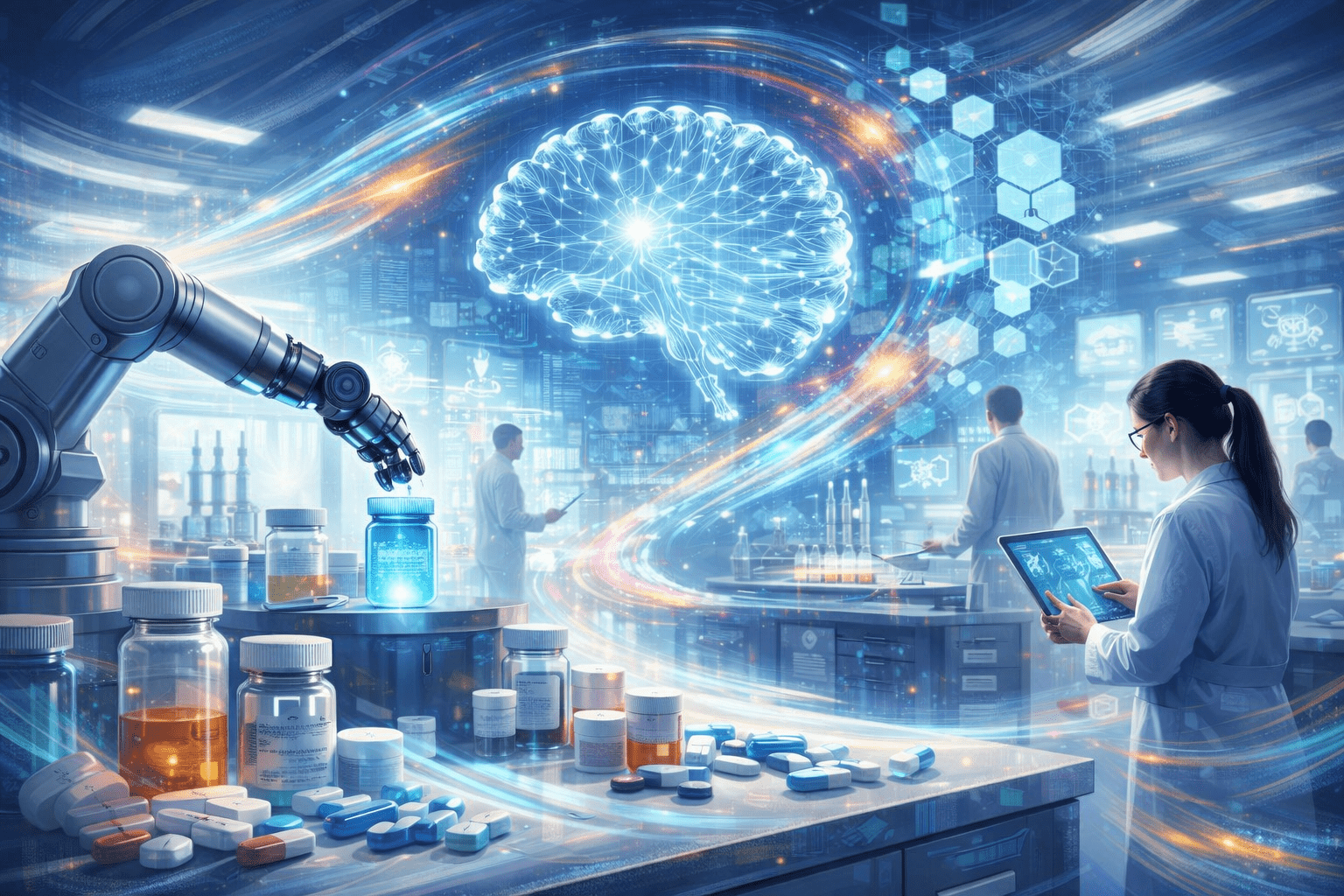
Artificial Intelligence is becoming structurally embedded in pharmaceutical industry processes. Not as an experimental technology, but as a concrete lever to improve efficiency, quality, compliance, and decision-making capabilities across the entire drug lifecycle. Capturing this transition is the white paper Artificial Intelligence in Pharma. Empowering Industrial Pharmacists for the Digital Era, developed by EIPG in collaboration with ISPE Italy.
What does using AI in Pharma mean today
In the pharmaceutical context, AI encompasses machine learning, deep learning, and generative artificial intelligence systems applied to manufacturing, quality, clinical development, regulatory affairs, supply chain, and pharmacovigilance. The primary value of AI lies not in replacing human expertise, but in augmenting human capabilities to analyze large volumes of data, identify complex patterns, anticipate risks, and support critical decision-making in highly regulated environments.
Why AI matters in a Highly Regulated Industry
The pharmaceutical sector is one of the most highly regulated industries worldwide. Any system that impacts product quality, safety, or efficacy must be validated, traceable, and inspection-ready. The white paper highlights that adopting AI requires a fundamental shift in approach: implementing advanced algorithms alone is not sufficient. What is needed is a robust governance framework that encompasses data integrity, cybersecurity, risk management, and alignment with emerging regulatory frameworks, from the EU AI Act to the latest guidance from EMA and FDA.
What is the role of the Industrial Pharmacist in AI
According to EIPG and ISPE, the industrial pharmacist plays a key role in the responsible adoption of AI. Their scientific and regulatory expertise makes them uniquely positioned to:
- assess the reliability of algorithmic models
- oversee validation strategies
- interpret AI outputs in relation to product quality and patient safety
- prevent bias, overfitting, and compliance risks
In other words, the industrial pharmacist becomes the point of balance between technological innovation and regulatory rigor.
Where AI is already delivering tangible value
The white paper documents numerous real-world use cases. In quality and manufacturing, AI is being used to:
- detect deviations and anomalous trends in process data
- support predictive maintenance and environmental monitoring
- automate visual inspection activities and line clearance
- analyze deviations and CAPAs through natural language processing (NLP)
In regulatory affairs and pharmacovigilance, AI enables the monitoring of regulatory updates, the analysis of adverse event reports, and the improvement of documentation management, reducing both timelines and the risk of errors.
AI and validation: the central issue
One of the clearest messages of the document concerns validation. AI models must be:
- explainable
- verifiable over time
- trained on representative, high-quality data
- monitored throughout their entire lifecycle
“Black box” logic is not compatible with a GxP environment. AI must be governed through a human-centric approach, with humans always remaining accountable for final decisions.
Why this White Paper matters today
The value of the EIPG–ISPE document lies not only in its technological overview, but in its ability to connect innovation, regulation, and professional roles. At a time when AI is becoming a systemic technology for the pharmaceutical industry, the white paper provides a clear compass: AI adoption is inevitable, but its credibility will depend on the quality of governance and on the role of industrial expertise.
For the pharmaceutical industry—and particularly for professionals working in quality, regulatory affairs, and operations—the message is unequivocal: AI is not merely a technological choice, but a cultural and professional one.