For more than a century, the pharmaceutical industry built its efficiency on the ability to manufacture large quantities of identical medicines while ensuring consistent quality, sustainable costs and broad availability across large patient populations. The industrial model was based on standardization: once a robust process had been developed and validated, value came from the ability to replicate it thousands or millions of times without altering its quality standards.
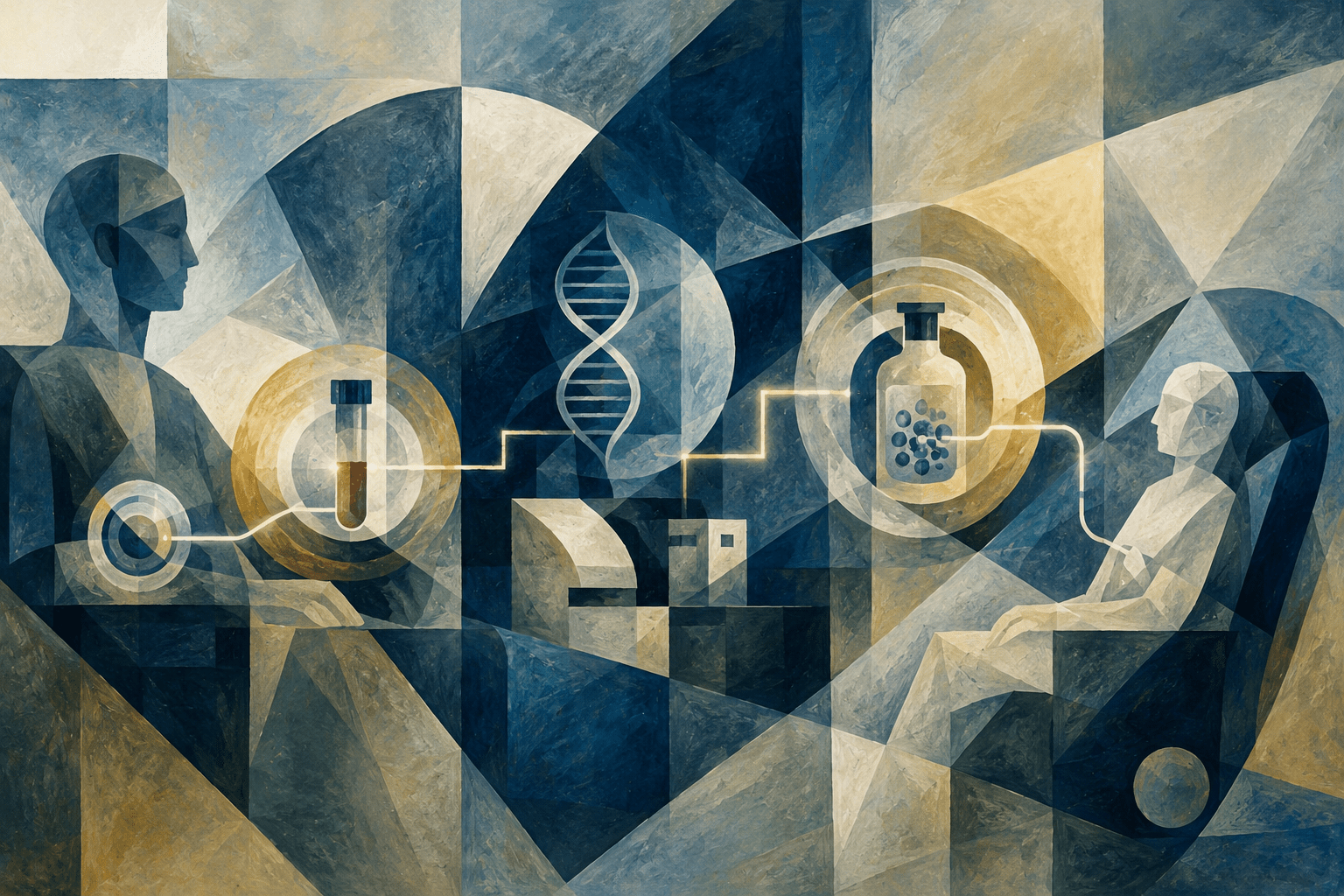
The arrival of advanced therapies is challenging this paradigm. In some cases, a medicine is no longer intended for a population of patients, but for a single individual. CAR-T therapies are the clearest example: cells are collected from the patient, modified in the laboratory and subsequently reinfused into the same individual. Each treatment therefore constitutes a unique batch, linked to a single biological and clinical identity.
Standardization does not disappear, but its focus changes. It no longer concerns the identity of the final product, which by definition varies from one patient to another, but rather the robustness of the process through which that product is obtained.
Manufacturing becomes a continuous journey
In traditional manufacturing, production, quality control, batch release and distribution are distinct stages, connected but clearly separated. In personalized therapies, these boundaries become much less defined, because the process begins at the clinical center, continues at the manufacturing site and ends once again in the hospital.
The collection of biological material, its transport to the GMP laboratory, cell manipulation, quality controls, batch release and shipment back to the treatment center are all part of a single pathway in which every step must comply with strict timelines. A logistical delay is not merely an organizational issue: it may compromise material stability, affect the therapeutic window or render the entire treatment unusable.
Manufacturing therefore no longer coincides solely with what takes place inside a production facility. It becomes a continuous chain connecting the patient, hospital, laboratory, quality functions, logistics and data.
Chain of Identity & Chain of Custody
The Chain of Identity ensures that the biological material and the final product remain linked to the same patient at all times. The Chain of Custody, by contrast, documents every transfer, manipulation and handover of responsibility throughout the manufacturing and logistics pathway.
In cell and gene therapies, both are integral components of the quality system. Their purpose is not only to reconstruct the product’s journey, but also to prevent identification errors, ensure traceability and demonstrate the compliance of the entire process.
The supply chain must protect identity
In conventional therapies, the supply chain handles raw materials, intermediates and finished products. In autologous therapies, it must also manage the patient’s identity. Every biological sample must be linked unambiguously to the person from whom it was collected and to whom it will subsequently be administered.
This is where the Chain of Identity and Chain of Custody become essential. The former ensures that cells, samples and the final product always belong to the same patient. The latter documents every transfer of the biological material, from collection and processing through to delivery to the clinical center.
These systems are not merely logistical tools. They are an integral part of product quality. An identification error does not simply result in a documentation deviation; it can compromise patient safety. Digital traceability, access control, temperature monitoring and the management of handovers and responsibilities therefore become essential elements of the entire manufacturing model.
Quality also takes on a new perspective
When a batch corresponds to a single patient, the meaning of quality control also evolves. In traditional models, the analysis of a representative sample makes it possible to assess the compliance of an entire production run. In personalized therapies, by contrast, each batch must be evaluated individually, often with only very limited quantities of material available and within timelines that are incompatible with some conventional analytical approaches.
The focus therefore shifts towards process robustness, data quality and proactive risk management. Manufacturing, Quality Control, Quality Assurance and logistics must operate in a far more integrated manner, because every deviation can have an immediate impact on therapy availability.
Quality is no longer verified only at the end of the process. It must be built into and documented throughout every stage of the pathway.
The factory becomes a network
Personalized therapies are also changing the very concept of the manufacturing site. The factory is no longer simply a clearly defined physical location, but a distributed network of clinical facilities, laboratories, GMP manufacturing plants, logistics providers and digital platforms.
Industrial value no longer depends solely on the equipment installed, but on the ability to coordinate different actors while maintaining continuity, traceability and compliance. In this context, digitalization and automation are not optional additions, but essential conditions for managing highly complex and individualized processes.
Manufacturing Execution Systems, sensors, traceability platforms and analytical tools make it possible to monitor each stage in real time, reducing the risk of errors and improving visibility across the entire manufacturing pathway.
A new economics of manufacturing
Personalization also raises an economic question. The traditional pharmaceutical manufacturing model is based on economies of scale: increasing production volumes allows fixed costs to be spread across a large number of units. In individualized therapies, this logic becomes less effective.
Productivity can no longer be measured solely by the number of packs produced or the yield per batch. It must also take into account process reliability, speed, flexibility, the ability to reduce failures and continuity of treatment.
The challenge is to maintain high quality standards without making the model economically unsustainable. Automation, modular platforms and standardized operations therefore play a decisive role: they do not make the products identical, but aim to make the way they are manufactured reproducible.
The patient becomes part of the industrial system
For many years, the patient represented the final point in the pharmaceutical value chain. With personalized therapies, however, the patient becomes an integral part of the manufacturing process. The pathway begins with the patient, moves through manufacturing and quality, and ultimately returns to the patient.
This circularity changes the way facilities, processes, information systems and responsibilities are designed. It is not limited to CAR-T therapies or other cell-based treatments, but may anticipate a broader transformation of pharmaceutical manufacturing towards smaller batches, greater flexibility and closer integration between clinical data and industrial processes.
Personalized therapies will probably continue to account for a limited share of overall production volumes, but their impact on the industry will be much broader. The solutions developed to manage traceability, automation, real-time control and distributed manufacturing may also influence conventional pharmaceutical production.
In the future of the industry, the concept of the batch will continue to exist. In some cases, however, that batch will correspond to a single person.
Vuoi trovare più facilmente MakingPharmaIndustry su Google?
Aggiungici alle tue fonti preferite