
On 25 November 2026, the European Parliament gave its final approval to the reform of European Union pharmaceutical legislation, completing a process initiated by the European Commission in April 2023.
The new regulatory framework, comprising a directive and a regulation, updates a legislative system largely dating back more than twenty years, addressing marketing authorisation procedures, regulatory protection, access to medicines and security of supply.
The approval follows the political agreement reached between Parliament and Council on 11 December 2025 and the adoption of the legislative texts by the Council on 28 September 2026.
The reform comes at a time of transformation in European industrial policy, in which the ability to develop, manufacture and ensure the availability of medicines is becoming increasingly strategic. Industrial competitiveness, healthcare system sustainability and security of supply are becoming interdependent components of EU pharmaceutical policy.
A new regulatory framework for medicines
The reform reshapes the architecture of European pharmaceutical legislation through two complementary legislative acts:
-
A directive establishing the new Union code relating to medicinal products for human use, replacing Directives 2001/83/EC and 2009/35/EC.
-
A regulation governing EU procedures for the authorisation and supervision of medicinal products for human use and the functioning of the European Medicines Agency (EMA), also replacing the specific legislation on orphan and paediatric medicines.
The integration of these provisions into a unified legislative framework responds to the need to adapt the regulatory system to scientific and technological developments, the growing complexity of medicinal products and the international dimension of supply chains.
For pharmaceutical companies, the transition will entail a reassessment of regulatory strategies throughout the entire medicinal product lifecycle, from the design of development programmes to the management of post-authorisation activities.
Regulatory protection and development strategies
One of the most widely debated aspects of the legislative process concerns the duration of regulatory protection granted to innovative medicinal products.
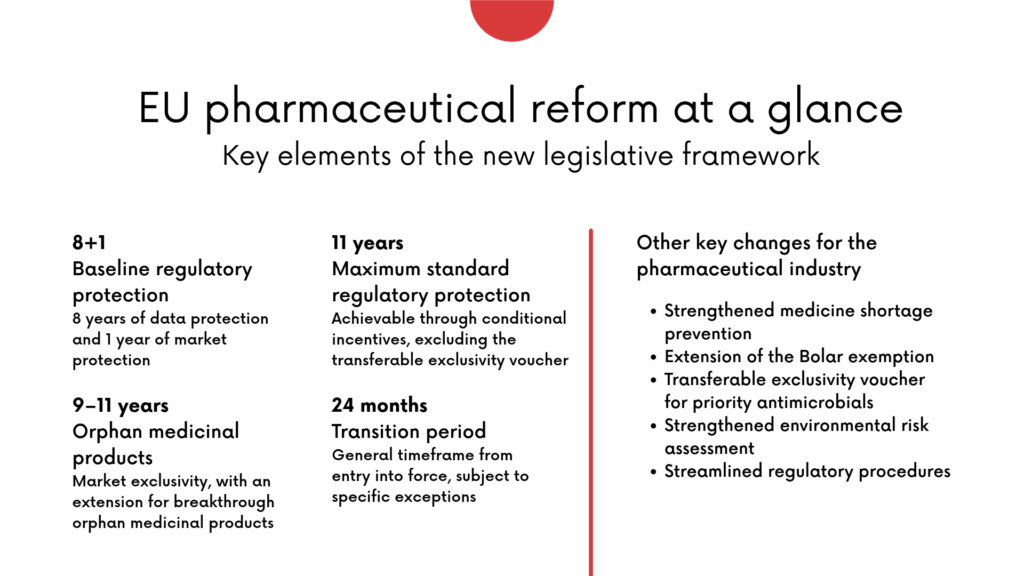
The new system provides for a baseline period of eight years of regulatory data protection, followed by one year of market protection, with possible extensions subject to specific conditions. The overall standard protection period may reach eleven years.
Factors relevant to these extensions include the conduct of comparative clinical studies, clinical trials across multiple Member States, the timely submission of marketing authorisation applications in the EU and the ability to address unmet medical needs.
Compared with the existing reference model, commonly referred to as 8+2+1, the reform changes the balance between baseline protection and conditional incentives.
Regulatory strategies will therefore need to take these conditions into account from the early stages of development. Decisions concerning clinical study design, comparator selection, the geographical distribution of clinical trials and the sequence of regulatory submissions may directly affect the commercial value of a product.
This will require closer coordination between research and development, regulatory affairs, market access and industrial planning functions.
Generics and biosimilars towards earlier market entry
The reform also addresses the Bolar exemption, which allows certain activities required to prepare generic and biosimilar medicines for market entry to be carried out before the expiry of intellectual property rights.
The extension of its scope includes participation in public procurement procedures, within the limits established by the new legislation. The objective is to reduce the interval between the expiry of applicable protection periods and the actual availability of therapeutic alternatives.
The industrial implications primarily concern the ability to initiate commercial launch preparations earlier through coordinated planning of development activities, technology transfer, process validation and raw material procurement.
Timely market entry will also depend on the availability of qualified manufacturing capacity and the strength of relationships with industrial partners, including contract development and manufacturing organisations (CDMOs).
Incentives for antimicrobials and orphan medicinal products
The new legislative framework introduces specific instruments to support the development of medicinal products in therapeutic areas characterised by unmet clinical needs and economic conditions that may limit investment in research.
For the development of priority antibiotics, the legislation provides for a transferable exclusivity voucher that can be used to obtain an additional year of regulatory protection, subject to the conditions and limitations established by the legislation.
For orphan medicinal products, a baseline market exclusivity period of nine years is established, with the possibility of extension to eleven years for products recognised as breakthrough orphan medicinal products, provided that the relevant requirements are met.
The effectiveness of these incentives will need to be assessed over time, taking into account their ability to direct investment towards therapeutic areas in which conventional development and remuneration models may prove insufficient.
Continuity of supply becomes part of regulatory strategy
Among the provisions of greatest relevance to the pharmaceutical industry are those addressing the prevention and management of medicine shortages.
The new framework strengthens product availability monitoring, shortage reporting obligations and the preparation of shortage prevention plans for critical medicines. Under certain conditions, Member States are also empowered to require the supply of medicinal products benefiting from regulatory protection in quantities sufficient to meet patient needs.
The ability to ensure continuity of supply is therefore becoming increasingly important in medicinal product lifecycle management.
As previously discussed in EU medicines, from authorisation to supply, the actual availability of a product depends on multiple factors, including industrial organisation, manufacturing capacity, supplier qualification and the management of dependencies throughout the supply chain.
For companies, the implementation of the new framework will provide an opportunity to assess the adequacy of their supply risk management systems. Knowledge of vulnerabilities associated with manufacturing sites, sources of active pharmaceutical ingredients (APIs) and suppliers of critical materials will need to translate into prevention tools and practicable mitigation measures.
Particular attention will need to be paid to outsourced manufacturing operations, where access to up-to-date information on manufacturing capacity and potential disruptions is essential for supply planning.
The link with the Critical Medicines Act
The reform of pharmaceutical legislation is progressing alongside the Critical Medicines Act (CMA), which was also approved by the European Parliament on 25 November 2026 through a separate legislative procedure.
The two legislative initiatives pursue complementary objectives. The revision of general pharmaceutical legislation strengthens regulatory instruments for shortage prevention and management, while the Critical Medicines Act addresses the industrial and commercial conditions that determine security of supply.
The CMA introduces instruments to support strategic projects aimed at establishing, modernising and expanding European manufacturing capacity, including the production of active pharmaceutical ingredients. It also provides for the integration of resilience criteria into public procurement procedures for critical medicines.
For European manufacturers, these developments could change the criteria used to assess the competitiveness of industrial offerings. Economic considerations will be complemented by factors such as the diversification of supply sources, supply reliability, manufacturing location and the ability to respond to disruptions.
The actual impact will depend on how the provisions are implemented and on the availability of investment support instruments.
Regulatory simplification and environmental sustainability
The reform also provides for the streamlining of EMA activities and marketing authorisation procedures, with the aim of reducing administrative burdens and improving the efficiency of the European regulatory system.
At the same time, greater emphasis is placed on the environmental risk assessment of medicinal products and the associated mitigation measures, including the potential contribution of antimicrobial substances released into the environment to the development of antimicrobial resistance.
These provisions further increase the importance of integrating environmental expertise into product development and lifecycle management activities. For the pharmaceutical industry, it will be important to assess the availability of information required to characterise environmental risks and to ensure coordination between regulatory affairs, manufacturing and sustainability functions.
From approval to implementation
Parliamentary approval marks the beginning of a new phase, during which attention will gradually shift from the legislative provisions to their implementation.
Publication in the Official Journal of the European Union, national transposition of the directive and the development of delegated and implementing acts will be key steps in defining the operational arrangements of the new system.
As a general rule, most provisions will become applicable 24 months after the legislative acts enter into force, subject to specific exceptions and transitional provisions.
For pharmaceutical companies, this period provides an opportunity to assess the impact of the reform on product portfolios, development strategies, information systems, shortage management processes and agreements with industrial partners.
The ability to integrate these assessments into corporate planning will be crucial in addressing a regulatory transformation that extends beyond regulatory affairs to encompass the entire industrial organisation.
Sources and regulatory references
-
European Parliament, 25 November 2026 – Green light for new rules governing the EU pharmaceutical sector.
-
Council of the European Union, 28 September 2026 – Pharma package: Council adopts new rules for a fairer and more competitive EU pharmaceutical sector.
-
European Parliament, Legislative Observatory – Procedure 2023/0132(COD) – Directive establishing the Union code relating to medicinal products for human use.
-
European Parliamentary Research Service, 16 November 2026 – EU pharmaceutical legislation: Towards a fairer and more competitive pharmaceutical sector.
-
European Medicines Agency – Reform of the EU pharmaceutical legislation.
-
Council of the European Union, 12 May 2026 – Critical medicines act: Council and Parliament reach provisional deal.
-
Council of the European Union – Critical Medicines Act – Legislative text ST 11059/2026.
Vuoi trovare più facilmente MakingPharmaIndustry su Google?
Aggiungici alle tue fonti preferite