
Artificial intelligence in healthcare has already moved beyond the stage of promise. It is no longer confined to research or pilot projects, but has become a tangible component of the MedTech industry’s offering.
The report “AI Adoption Gap in Healthcare”, promoted by Intesa Sanpaolo and Università Campus Bio-Medico di Roma, clearly reflects this level of maturity, while at the same time highlighting an increasingly evident gap between technological development and real-world adoption.
The data leave little room for ambiguity: 78% of companies have already integrated artificial intelligence solutions, and 61% are in advanced stages of development or validation.
This means that AI is already market-ready, often even for large-scale implementation. Yet its diffusion across clinical and organizational settings remains limited, indicating that the issue lies not in the availability of technologies, but in the system’s capacity to absorb them.
What the AI adoption gap really means
The adoption gap does not indicate a lack of innovation, but rather the distance between technological development and its actual use within the healthcare system. In the case of artificial intelligence, this gap emerges when already mature solutions fail to be integrated into clinical and organizational processes.
In the report “AI Adoption Gap in Healthcare”, this divide is clearly visible: on one side, a dynamic industrial ecosystem in which many companies have already incorporated AI; on the other, a healthcare system that struggles to absorb these innovations at scale.
The adoption gap develops along the value chain: during the development phase, due to regulatory complexity and validation requirements; in market access, with uncertain reimbursement pathways; and in implementation, with issues related to interoperability, skills, and resistance to change.
It is therefore not a technological problem, but a misalignment between innovation and the system.
The paradox of innovation available but not used
The gap between what is developed and what is actually adopted lies at the core of the so-called “adoption gap.” Technologies exist and are mature, yet they struggle to enter the processes of the Italian National Health Service and to reach patients in a systematic way.
This gap is not episodic, but structural.
The report shows that Italy has a solid and innovative industrial base, yet fails to translate this capacity into clinical and economic impact.
The result is a loss of value along the value chain: what is created is not fully utilized.
The barriers are not technological
One of the most relevant findings of the study concerns the nature of the obstacles. Companies do not point to technological limitations, but to systemic constraints. Regulatory complexity, difficulties in accessing resources for certification and validation, and limited funding represent the main barriers to development.
As the focus shifts to the adoption phase, additional challenges emerge:
- uncertainty in reimbursement pathways
- interoperability issues with existing systems
- cultural resistance slowing the introduction of innovation in operational settings
The conclusion is clear: the barriers are systemic and structural, not technological.
The real bottleneck is organizational
The report clearly identifies the point of friction: the main barrier to the adoption of artificial intelligence is institutional and organizational in nature.
In its current configuration, the Italian National Health Service is not designed to rapidly integrate innovation—especially when this requires changes in decision-making models, evaluation processes, and funding mechanisms.
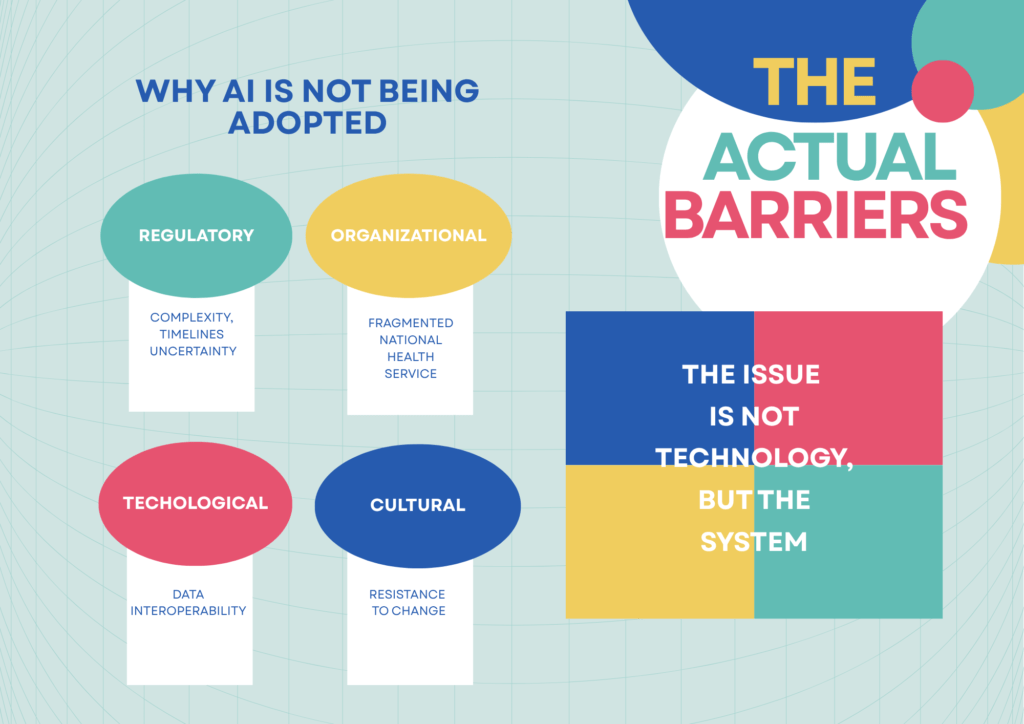
Regional fragmentation further exacerbates the problem, creating disparities in access to technologies and making it difficult to scale solutions.
In this context, SMEs—which make up the majority of the sector—demonstrate strong innovation capacity in the early stages, but face significant challenges when moving toward large-scale deployment.
An innovation still too hospital-centric
A further critical issue concerns the direction of innovation.
Healthcare challenges are increasingly shifting toward community-based care, driven by population aging and the rise of chronic diseases. Yet most solutions continue to be developed for hospital settings, where business models are more established and validation pathways are clearer.
This misalignment between system needs and technological development risks further limiting the impact of AI, slowing the transformation of care models and their evolution toward more distributed, community-based management.
The risk is systemic, not only industrial
The lag in the adoption of artificial intelligence does not have exclusively industrial consequences.
The report highlights how a lack of acceleration could impact:
- the country’s competitiveness
- the sustainability of the Italian National Health Service
- equity of access to care
In an international context where AI is becoming increasingly central to healthcare strategies, the adoption gap risks translating into a loss of strategic positioning, both economically and in terms of quality of care.
From adoption to innovation governance
The overall reading of the report leads to a clear conclusion: artificial intelligence cannot be managed as a standalone technology, but must be considered a lever for systemic transformation.
For this reason, overcoming the adoption gap requires coordinated action across multiple levels—from regulation to data infrastructure, from reimbursement models to skills development.
The real shift, therefore, is not about the ability to innovate, but the ability to govern innovation. It is on this ground that the Italian healthcare system’s capacity to turn artificial intelligence from a technological opportunity into a real driver of change will be determined.
Vuoi trovare più facilmente MakingPharmaIndustry su Google?
Aggiungici alle tue fonti preferite